
Michelle’s Journey: From Delayed Diagnosis to Living Well
Key Takeaways
- Michelle spent nearly five years seeking answers for unexplained weight loss, severe fatigue, nausea, and weakness before receiving an Addison’s disease diagnosis, despite repeatedly being told her tests were normal.
- Living with Addison’s disease, autoimmune polyglandular syndrome type 2, and aggressive psoriatic arthritis has caused drastic changes in Michelle’s life and independence, due to daily pain and her complex treatment plan.
- After leaving her 25-year career as an educator, Michelle found a new sense of purpose through Living Well When You’re Not, a blog and book about navigating life with chronic illness.
- By encouraging self-advocacy and raising autoimmune awareness, Michelle hopes to help others find answers, build supportive relationships with their healthcare providers, and understand that illness does not determine worth.
The “Tired Working Mom”
For years, Michelle was labeled as the “tired working mom.” While motherhood can be very draining, what Michelle experienced was more than just being tired. After the birth of her second daughter, she began losing weight without explanation and experiencing crushing exhaustion, nausea, and spells of weakness so profound that it felt as though lead had been poured into her bones.
Doctor after doctor told her that her tests were normal. One physician even suggested to her husband that she might be mentally unstable. After repeated dismissals, Michelle began questioning herself and wondering whether she could trust what she was experiencing. Yet something inside her continued to insist that something was wrong. She knew her body was changing, and she refused to give up on finding an explanation.
Her story illustrates how profoundly isolating unexplained symptoms can be. It also shows the importance of resilience—despite years of uncertainty, Michelle continued searching for answers and trusting her intuition even when others questioned it.
Finding a Clue to an Elusive Diagnosis
Michelle’s breakthrough came unexpectedly while she was waiting for an appointment with her allergist. In the waiting room, she picked up a magazine article about former President John F. Kennedy’s Addison’s disease, a chronic endocrine disorder in which the adrenal glands can’t produce enough cortisol and aldosterone. While reading this piece about JFK, Michelle recognized similarities between his condition and her own symptoms.
In response, Michelle asked her allergist to test her for Addison’s disease. Her cortisol levels came back dangerously low, so she was referred to an endocrinologist. For the first time, she had a promising lead that could explain years of unexplained illness.
Seeking a Second Opinion
This promising lead almost led to a dead end when the head of the endocrinology department dismissed the possibility, telling Michelle that Addison’s disease was rare and therefore she probably did not have it. Refusing to be dismissed so easily, Michelle focused on finding a specialist who would listen to her. She got a second endocrinologist to order targeted tests that ultimately confirmed the diagnosis; as she suspected, she had Addison’s disease.
Nearly five years had passed since her symptoms began, so Michelle was relieved to finally have an explanation, but she also felt frightened and alone. She knew living with an autoimmune disease wouldn’t be easy. She’d have to learn how to manage this rare, lifelong condition with little guidance.
Facing Multiple Autoimmune Diseases
Even though Michelle thought she had some clarity after getting an autoimmune disease diagnosis, learning she had Addison’s Disease was only the beginning of her journey. Over the following decade, she developed additional conditions that made managing her health increasingly complicated.
Receiving Additional Diagnoses
About 10 years after her initial diagnosis, Michelle learned she had autoimmune polyglandular syndrome type 2 (APS-2), which is a rare, polygenic disorder where the immune system attacks multiple hormone-producing endocrine glands. APS-2 always includes Addison’s disease as the core condition, but in Michelle’s case, it also included both Type 1 diabetes and Hashimoto’s thyroiditis, while some people with APS-2 only have one of these additional components.
During those 10 years, Michelle was also diagnosed with an aggressive form of psoriatic arthritis. Each of her conditions brought additional symptoms and treatment needs, requiring her to adapt continually as her health changed.
Managing Complex Treatments and Daily Pain
Although some days are better than others, Michelle lives with pain every day. She takes medication five times a day and receives infusions every six weeks. Michelle has also undergone several surgeries, including:
- Two spinal fusions
- Two fusions in her feet
- Joint replacement surgeries in her fingers
Living with multiple autoimmune diseases usually requires coordination with multiple specialists, navigating complex treatment plans, and adjusting to new limitations. For Michelle, these physical demands have also been accompanied by emotional challenges, as her illness affects her independence, relationships, and daily activities.
When Chronic Illness Took Her Career
Fatigue and pain increasingly limited what Michelle could do. Accordingly, after 25 years of teaching, she had to step away from her role as an educator and reconsider the future she had envisioned for herself. Teaching had been a major source of identity, purpose, and connection for her, making leaving her career one of the most painful turning points in her journey.
With this change, Michelle also grieved the loss of independence and the ability to participate in life as she once had. After years of being the strong person who could handle anything, she struggled to understand who she was when she could no longer fulfill those familiar roles, a common challenge that people coping with autoimmunity face.
Redefining Her Sense of Worth
Michelle sometimes felt she had to justify her existence or explain why she needed help. Over time, however, she began to recognize that her worth was never tied to her productivity or independence—this realization did not erase her grief, but it helped her see that she remained a whole person beyond her career and physical abilities. She could mourn the life she had lost while gradually making room for a different future.
Learning to Live Well When Life Changes
As Michelle adjusted to life with chronic illness, she began shifting her focus from trying to return to her former life toward discovering what was still possible. That change eventually inspired a project that would help her find purpose in a new way.
Creating Living Well When You’re Not
Michelle started Living Well When You’re Not as a blog and website to share reflections and practical wisdom for people whose lives have been changed by chronic illness. The project later grew into a book, Living Well When You’re Not: Chronic Illness and the Art of Living in the In-Between.
Writing has helped Michelle process her experiences and connect with others facing similar challenges. She learned that although she could not control her diseases, she could still make decisions on how to live with them.
Becoming an Advocate for Her Own Care
Years of having her symptoms dismissed taught Michelle how important it is to trust her own observations. She has become more confident in communicating changes, asking questions, and playing an active role in the decision-making process for her treatments.
Building Partnerships With Healthcare Providers
Like many patients, Michelle values physicians who do these four things:
- Listen to her concerns and health-related desires
- Understand her medical history
- Recognize how her conditions and medications may interact
- Prioritize honesty and compassion
Her relationship with her rheumatologist demonstrates that last point very well. When Michelle asked whether her worsening arthritis meant the disease was progressing, her doctor confirmed that it was and that medication could slow the disease but could not cure it.
Although the news was difficult, having an honest conversation with a trusted physician helped Michelle begin reconsidering her care plan—all patients deserve medical relationships built on trust, communication, and a willingness to adapt treatment when circumstances change.
Navigating Insurance Barriers
Accessing recommended treatment has not always been straightforward for Michelle. After trying several arthritis medications, she found one that appeared to be keeping her condition under control. When her rheumatologist changed her medication, the insurance company denied the new treatment twice.
Her rheumatologist ultimately had to participate in a peer-to-peer review to secure approval. The process took months, during which Michelle’s arthritis continued to worsen.
Her experience demonstrates how insurance delays, including ones from step therapy and prior authorization, can affect patients’ symptoms and quality of life. It has reinforced her commitment to advocating for appropriate care while working with medical professionals who are willing to advocate alongside her.
Redefining Strength and Asking for Help
For much of her life, Michelle was the person others could count on. Learning to accept help as chronic illness changed her abilities challenged her long-held understanding of strength and independence. Even now, asking for assistance can stir up feelings of shame. Michelle sometimes catches herself explaining that she needs help only because she physically cannot manage something alone.
She is gradually learning that she does not have to earn support by proving how much she can accomplish independently. Receiving care is part of living well, too.
Finding Connection Beyond Illness
Michelle was able to find support in family, friends, and her faith community, each of which has helped her navigate difficult periods. Spending time in nature and engaging with the arts also remind her that her life contains more than symptoms, treatments, and medical appointments.
These connections do not eliminate the challenges of chronic illness, but they help Michelle maintain a sense of identity beyond her diagnoses.
She encourages others to grieve what illness has taken from them while remaining curious about who they are beyond the roles they once played. Strength can mean advocating for treatment, but it can also mean resting, accepting help, and showing themselves compassion on difficult days.
Turning Personal Experience Into Advocacy
Michelle’s experiences have shaped her commitment to raising awareness of autoimmune disease—she understands how easily symptoms can be misunderstood when conditions are rare, or illnesses are invisible.
Raising Awareness of Autoimmune Disease
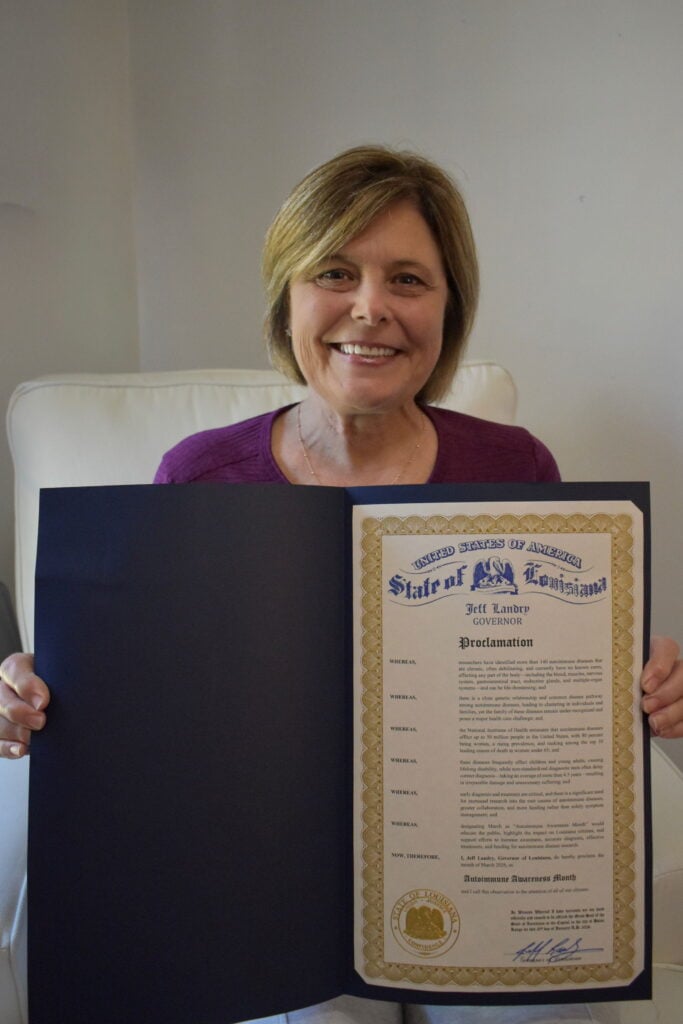
Her advocacy has included helping secure a proclamation from the State of Louisiana declaring March as Autoimmune Awareness Month. For Michelle, efforts like this help the public better understand the people behind autoimmune diagnoses and the challenges they face.
Awareness also means recognizing commonly shared experiences across different conditions, such as:
- Delayed diagnosis
- Chronic pain
- Fatigue
- Complicated treatment plans
Calling for Better Research and Coordinated Care
Michelle believes greater physician education, earlier diagnosis, and more research into the connections among various autoimmune diseases could improve patients’ lives. People with multiple conditions may see several specialists, even though their health needs are interconnected.
She hopes a stronger collective voice will encourage better coordination among healthcare providers, greater research investment, and improved access to recommended treatments.
Michelle also wants people to understand that someone can look healthy while experiencing debilitating symptoms. By sharing her story, she hopes to help patients feel heard and encourage families, employers, healthcare professionals, and policymakers to recognize the realities of invisible illness.
Finding Community Beyond a Rare Diagnosis
The Autoimmune Association offers a community for people navigating similar challenges as Michelle, regardless of their specific diagnosis. Through our educational resources, advocacy initiatives, and commitment to advancing autoimmune research, our organization helps patients find information, raise awareness, and connect with a broader movement working to improve care.
If you or someone you love is living with an autoimmune disease, check out the Autoimmune Association’s patient resources, and remember that you are not alone in this journey.
Join our email list
Receive the latest blog articles, news, and more right to your inbox!
Related articles you might be interested in

How Zuha Refused to Let Lupus Write Her Story
AJ’s Journey: Finding Answers After Years of Uncertainty
Aliana’s Journey: Living with MS and Finding Community
Hillary’s Journey: Living with Lupus and POTS
Find more resources on autoimmunity
Learn more about autoimmunity, diagnosis tips, how to find a physician, and more.