
Study Reveals Top Environmental Concerns Impacting Autoimmune Patients
When a hurricane hits or a wildfire spreads, most people worry about the obvious—flooding, smoke, power outages. But for people living with autoimmune diseases, the fear runs deeper. When the power goes out and the refrigerator stops working, temperature-sensitive medications can be compromised, often triggering disease flares that are painful, disruptive, and potentially dangerous.
That finding was one of the highlights amplified on a poster presented by the Autoimmune Association recently at the National Health Council’s Science of Patient Engagement Symposium: Medicine, MedTech, and AI. The Autoimmune Association, in collaboration with top rheumatologists and researchers across the country, helped conduct the signal-seeking national survey to better understand how extreme weather impacts people with autoimmune and rheumatic diseases. Early findings were surprising, not because there wasn’t a connection between weather and disease flares, but because the leading issues were somewhat unanticipated.
The online survey asked patients to identify the most intense autoimmune flare they experienced between July 2022 and today and whether those flares occurred within 90 days of a major weather event, such as a heatwave, storm, wildfire, or significant freeze. Participants also shared how these events affected their mental health, their access to care, and their ability to store or transport medications.
One early and alarming finding: 12% of participants said their worst flare happened within three months of their worst weather event. And the most common trigger? Improper medication storage caused by power outages. Without refrigeration, vital drugs can lose effectiveness, leading to worsening symptoms and emergency interventions.
“We were a little surprised by the initial findings,” said Dr. Iazsmin Ventura, and the project lead on the study. “But given that heat is the single greatest stressor reported it stands to reason that medication storage can be highly problematic.”
Extreme weather events also take a toll on patients’ mental health, with 66% of respondents reporting increased stress or anxiety tied to extreme weather and subsequent disease flares.
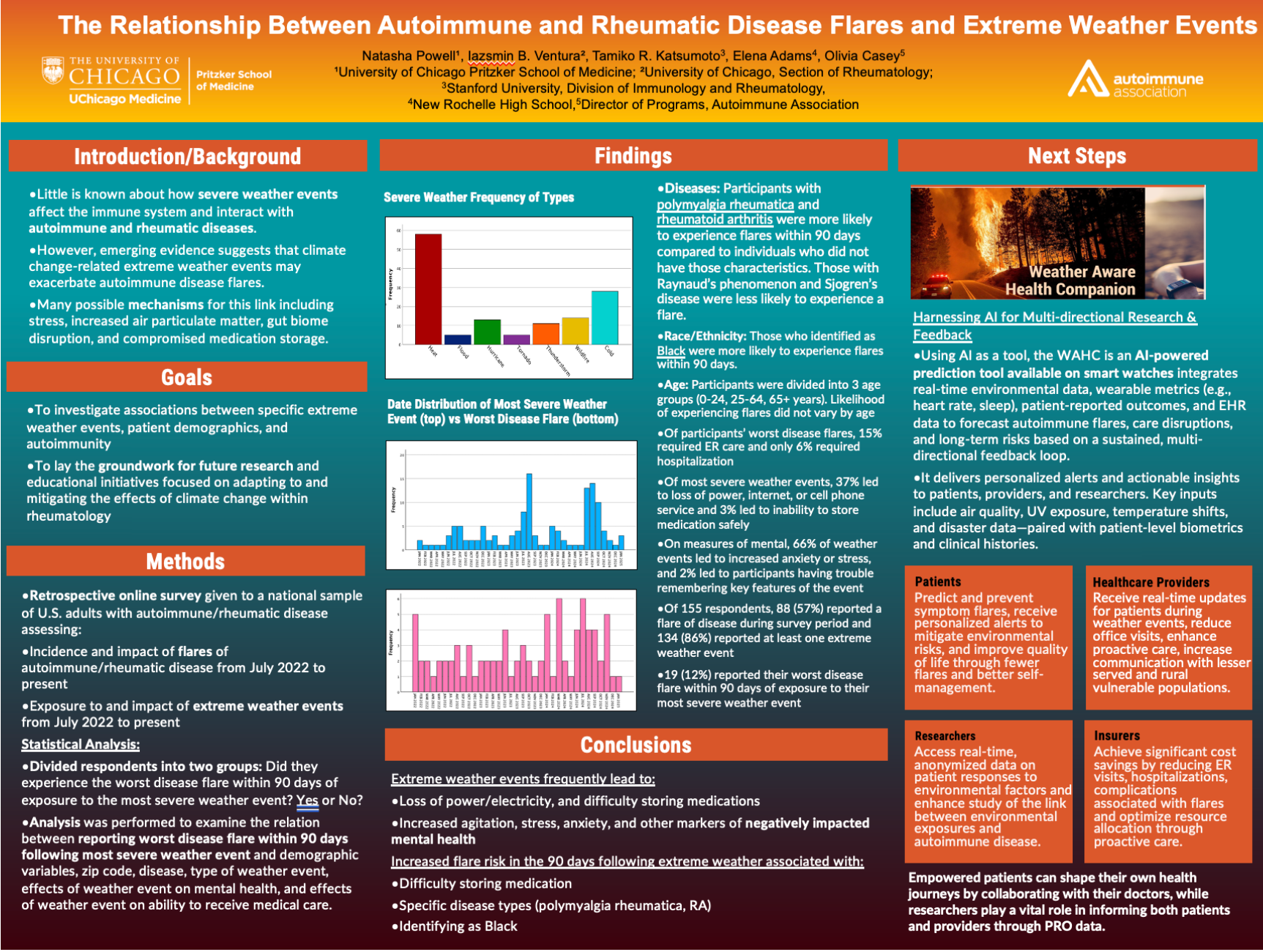
Also highlighted during the poster presentation is a proposed futuristic app designed to help facilitate better weather awareness among patients while feeding real-time responses back to both patients and researchers. This exciting innovation in development is the Weather-Aware Health Companion (WAHC), a conceptual mobile tool that will leverage real-time environmental data, wearable health inputs, and AI to help patients anticipate and prepare for potential disease flares triggered by environmental events. In return, patients can help inform research through sharing the impact of weather events on their disease flares and lived experience. It’s designed so that everyone – patients, providers and researchers – wins and has an opportunity to deepen our understanding of severe weather’s impact on autoimmune disease.
Imagine getting an alert on your watch that a heatwave is coming, with personalized suggestions on hydration, medication storage, and stress management, before symptoms even start. That’s the kind of support WAHC aims to provide.
And the work continues. A next generation survey (in Spanish) is now live, building on what has been learned so far. If you’re living with an autoimmune disease and want your voice heard, we want you to be part of it. Your experience could help shape the future of research, care, and climate resilience for millions.
View the full poster here.
RELATED RESOURCES
Join our email list
Receive the latest blog articles, news, and more right to your inbox!
Related articles you might be interested in

The Autoimmune Association Announces 2026 Young Adult Advisory Council
The Autoimmune Association Announces New Leadership for Board of Directors
The Hidden Workforce Impact of Autoimmune Disease on Women
Autoimmune Awareness Month: Why Awareness Matters
Find more resources on autoimmunity
Learn more about autoimmunity, diagnosis tips, how to find a physician, and more.